

PyHermes#
PyHermes is the Python implementation of Hermes, an in situ
multiresolution framework for cosmic statistics. A particle catalogue is
projected once into a reusable scaling-function-coefficient field
(SFCField). Smoothing, binning, multipole projection, and differential
operations are then expressed as windows acting on that field.
This field–window language supports count-in-cell statistics, isotropic and anisotropic 2PCFs, standard and multipole 3PCFs, marked and weighted statistics, and derived physical fields such as velocity divergence, Newtonian potential, and acceleration.
Project links: GitHub repository | Issue tracker | PyPI package | Hermes paper | Tutorial notebooks
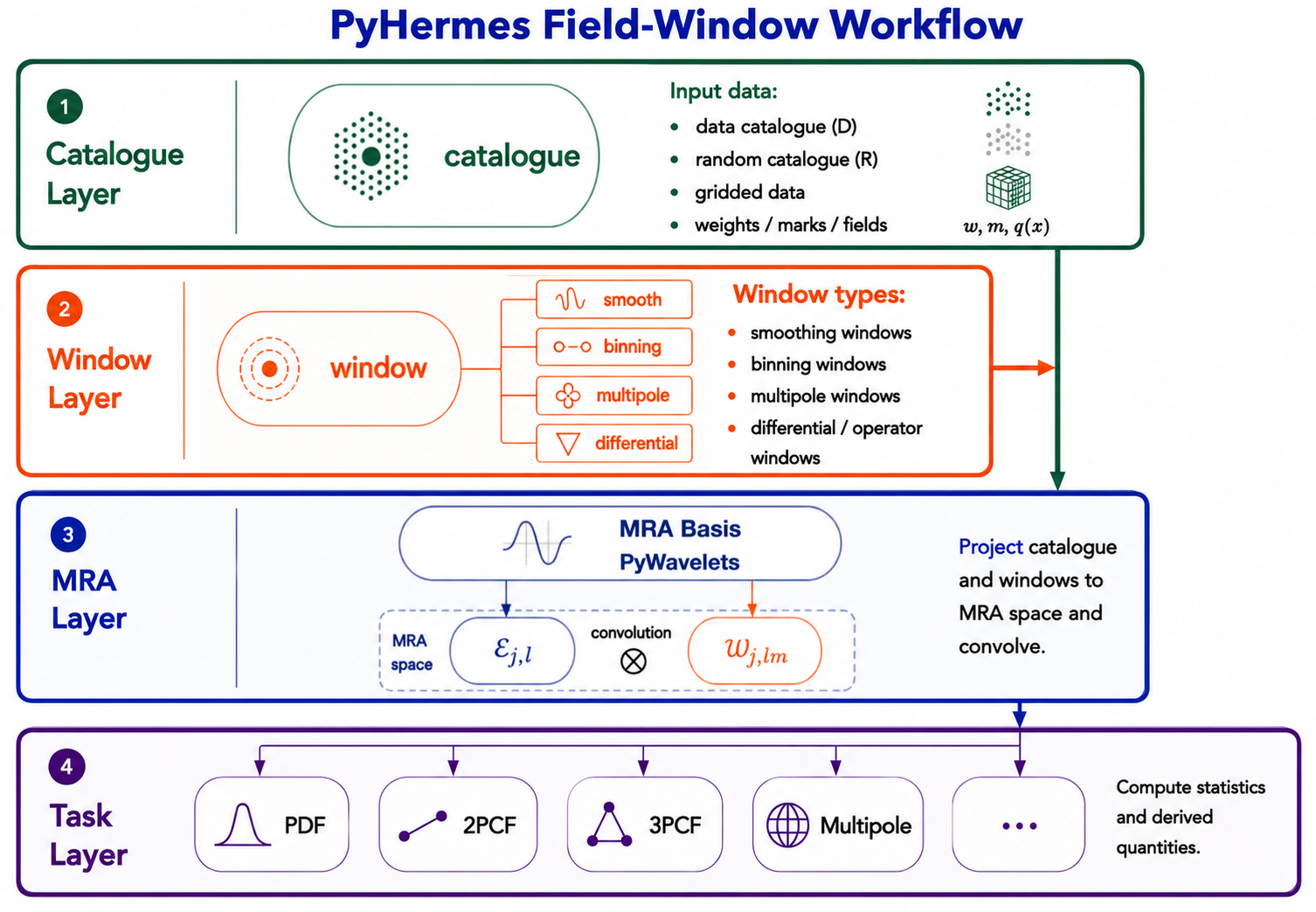
The four-layer PyHermes workflow used in the Hermes paper. Catalogue data and window operators meet in the MRA layer; task objects assemble the resulting filtered fields into statistics or physical diagnostics.#
The shortest route through the documentation is:
Hermes in one page for the algorithm and its scope.
Installation and Quick start for a first run.
Particle input and conversion when adapting your own catalogue.
Build an SFCField and Field and window operations for the two reusable core objects.
Choose an application path: physical fields, Counting, 2PCF, standard 3PCF, or 3PCF multipoles.
The public examples directory is the executable companion to this guide. Its notebooks are tutorials; its scripts and YAML files are production-shaped starting points.
The notebook gallery renders those same tracked notebooks directly in this site, including their saved figures and outputs.
Start here
Field--window concepts
- Hermes concepts and equations
- Build an SFCField
- Field and window operations
- Window reference
- Basic construction
- Built-in ordinary windows
- High-pass and wavelet-like filters
- Differential and inverse operators
- Smoothing windows and binning windows
- Line-of-sight geometry
- 2PCF sampling mappings
- 3PCF-multipole radial mappings
- Radial multipole profiles
- Custom ordinary Fourier windows
- Window arithmetic and its projection caveat
- Kernel modes
- Practical checks
Physical fields and statistics
Notebook tutorials
Reference and validation